
3 juli 2026/8 min leestijd
We Tried to Buy a Dead Link on Every Shopping Agent We Track — Several Let Us Reach Checkout
We took one confirmed-delisted 1688 listing and tried to buy it on every shopping agent in our directory. On several, nothing stopped us: we submitted an order and reached a live payment page for a product that no longer exists. Here is who did it, who did not, and how to protect yourself.
If you shop through a Chinese buying agent, you assume that when the site shows you a product with a price, an "Add to Cart" button, and a stock count, that product is actually available to buy. That assumption is doing a lot of work — and on some platforms, it is wrong.
We took a single listing that we had already confirmed was dead — delisted at the source, gone — and tried to buy it on every shopping agent in our directory. On several of them, nothing stopped us. We added it to the cart, submitted the order, and landed on a live payment page, ready to hand over money for something that no longer exists.
This is what we found, who did it, who did not, and what it means for you as a buyer.
TL;DR
We ran one confirmed-delisted 1688 listing through the "add to cart → submit order → checkout" flow on every shopping agent we track. Seven behaved in ways worth reporting. As of our test on 2026-07-03:
- Four platforms — GTBUY, LITBUY, OOTDBUY, BOONBUY — let us submit an order and reach a live payment page for a product that no longer exists at the source.
- The starkest case: GTBUY's own interface flagged the item as "expired," then still generated an order and sent us to checkout. It knew, and it took the order anyway.
- MYCNBOX did the right thing: it detected the dead link, warned us, and pulled the product.
- Two now block it. OOPBUY intercepts the link (its support calls the older behaviour a bug they are fixing), and LOLOBUY now errors out at order submission — though its product page still shows the item as buyable.
One boundary, stated up front: we can prove the checkout behaviour with screenshots. We are not claiming any platform ships you a substitute or its own stock ("self-shipping"). That would require a completed, paid order to verify, and we have not done that. See "What we did not prove."
Platform behaviour is a moving target — some of it changed while we were still testing — so every finding below is dated.
Why this matters
On any store with a payment step, showing you a product implies you can buy it. When the source listing is dead — the seller delisted or deleted it — an agent that still lets you pay opens a gap between what you paid for and what can actually be sourced. After you pay, one of three things happens:
- The buyer re-sources it from the original merchant, if they can find it — still legitimate agent buying.
- They cannot, and you wait out a delayed refund — wasted time, tied-up money.
- They fulfil with a substitute or their own stock — you receive something other than the exact listing you chose.
Outcome #3 is the one buyers worry about. To be clear: we did not prove it happens (see below). What we did document is that several platforms remove the one safeguard that would prevent it — they take the order for a product they should know is gone.
How we tested
We designed this to be reproducible:
- Scope. We ran the test across every agent platform in our directory, not a hand-picked few. The seven discussed here are the ones where the result was notable; the rest either could not resolve the link or behaved unremarkably.
- Probe. A single 1688 listing, ID 988620310856, independently confirmed delisted (it fails a live availability check at the source).
- Action. On each agent, paste the same link, add to cart, submit the order, and observe the checkout page. We stopped before paying.
- Pass/fail line. Does the platform generate an order and reach a payable checkout for the dead link?
- Date. 2026-07-03. The same dead link produced slightly different totals across platforms (USD 20.6–20.99), which is itself a small sign that each platform prices and handles the item independently.
- Volatility. Platforms patch. We date-stamp each result and re-checked where behaviour changed (see LOLOBUY).
What we found, platform by platform
Ordered by severity.
1. GTBUY — flagged the item as expired, then charged anyway
GTBUY is the clearest case here, because it removes any "they did not realise" defence. When we opened the cart, GTBUY itself displayed a red notice: "The items in the shopping cart have expired." The platform told us the listing was gone.
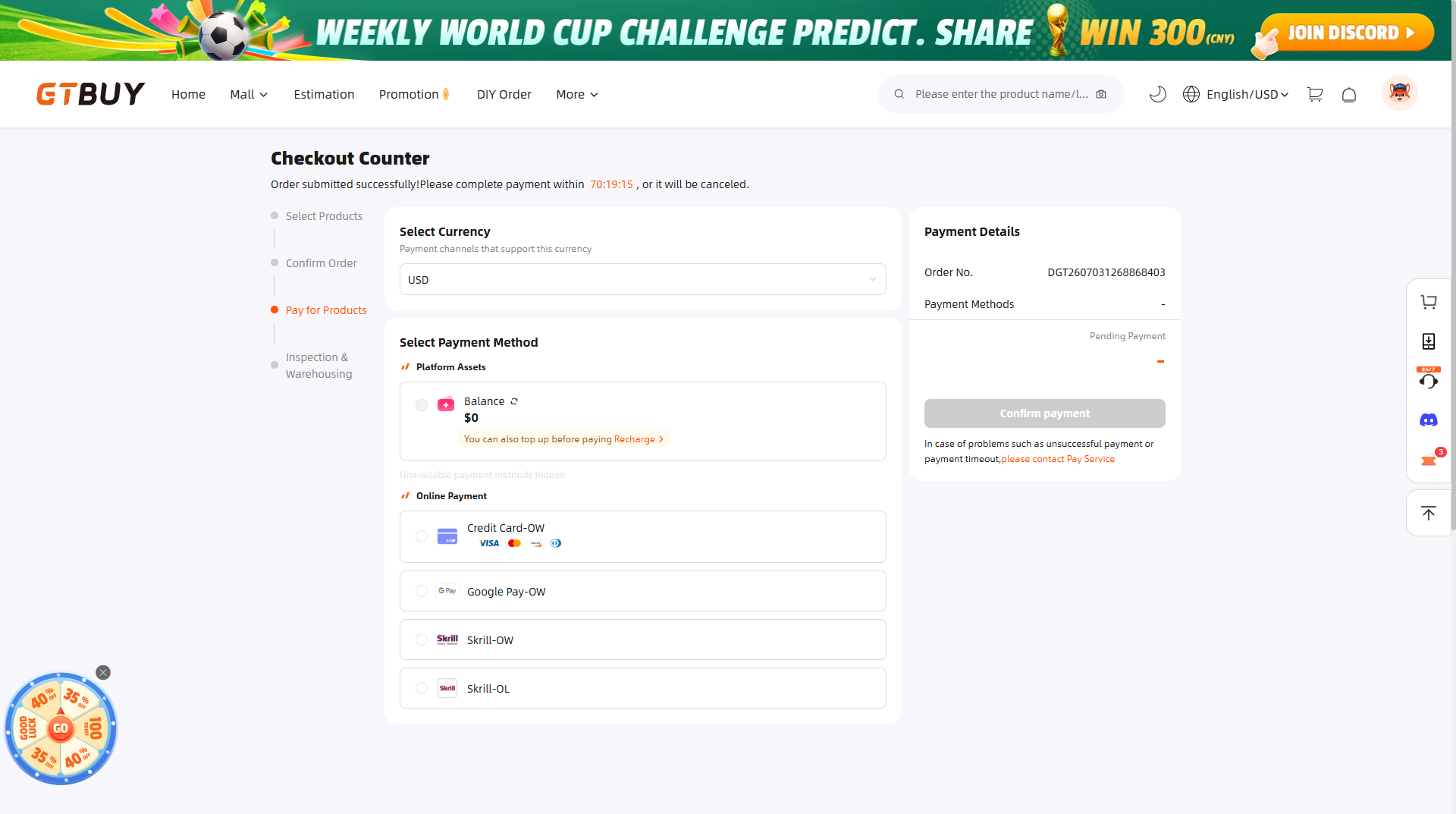
We submitted the order anyway — and it went through. GTBUY generated order number DGT2607031268868403, dropped us on a checkout page with a payment countdown, and offered credit card, Google Pay, Skrill and PayPal, all live.
In other words: the system knew the item had expired, said so on screen, and still routed us to pay. That "expired" message is only a soft front-end cart notice; the order-submission path has no hard availability gate behind it. The warning is cosmetic. The money step is not blocked.
2. LITBUY — order submitted, checkout live
LITBUY accepted the dead link without complaint. We reached a page reading "Order submitted successfully," with a deadline to pay, USD 20.77 due, and a full set of live payment options — Visa/Mastercard, Klarna, Skrill, Google Pay and PayPal.
3. OOTDBUY — order submitted, checkout live
OOTDBUY carried the dead link to its cashier, at the "Pay for Products" step, with USD 20.6 due and USDT, USDC and Google Pay available to pay.
4. BOONBUY — order submitted, checkout live
BOONBUY showed "Order submitted! Please pay by [deadline]," advanced to its "Payment of order fees" step, and listed Total Due USD 20.72 with Visa/Mastercard, Afterpay, Google Pay and Skrill.
5. LOLOBUY — was buyable; now blocks at submission (but the display still says otherwise)
When we first tested, LOLOBUY carried the dead link all the way to checkout. On a re-check the same day (2026-07-03), the behaviour had changed. The product page still loads the delisted item and still shows Add to Cart, Buy Now, and a stock count — but attempting to order now throws a validation error, "shopName must not be blank," because a delisted link carries no authoritative shop name. The payment step is now blocked.
Worth flagging for buyers: the block is real, but the display is still misleading — the page presents the item as in stock and buyable right up until you try to order.
6. MYCNBOX — did the right thing
MYCNBOX is the counter-example. It detected the dead link, showed a warning, displayed "Removing products from the mall," and pointed us toward a refund. It still surfaced the product, but it did not pretend the item was buyable or walk us into a payment page. This is the responsible way to handle a dead source link.
7. OOPBUY — blocked, and being fixed
OOPBUY intercepted the dead link rather than taking the order. Its customer support described the earlier buyable behaviour as a bug they are fixing. We are listing OOPBUY here as resolved, not as an offender — the point of a fair test is to record who handles this correctly, and OOPBUY now does.
Two things worth noticing
Same software, different versions. OOPBUY, BOONBUY and GTBUY appear to share a single white-label platform (technical fingerprints in the appendix). Yet OOPBUY has patched the behaviour while BOONBUY and GTBUY still let the order through — the same codebase at different update states. Sharing a vendor does not mean sharing a fix.
Some platforms are already moving. OOPBUY's support framed the older behaviour as a bug in progress, and LOLOBUY, on re-check, now blocks the order at submission. The picture is not static — which is exactly why every result above is date-stamped.
What we did not prove
We want to be precise about the limits of this test:
- We proved that a delisted link can still reach a payable checkout. We did not pay any order.
- We therefore cannot say these platforms "self-ship" or substitute goods. That claim would require a completed, paid order and inspection of what actually arrives. Until someone does that, treat substitute/self-shipping strictly as a risk, not a finding.
- We tested the platforms in our directory. Others may behave differently, and behaviour changes over time.
How to protect yourself
- Check whether the source link is still live before you buy. This is exactly what we do — we detect and archive dead listings, so we are the layer that takes them down rather than the one that keeps selling them.
- If a platform still lets you order a questionable link, ask support before paying. Two direct questions: can you get the original item from the original merchant? And if not, what is the refund path and timeline?
- Keep your order number and the support conversation in case you need to dispute or request a refund.
For the mechanism behind why an agent might ship you a substitute in the first place — and a full buyer-safety checklist — see our neutral guide, How to Avoid Order Swapping When Using a Shopping Agent.
Appendix — technical fingerprints (for the curious)
- Each platform's app calls its own API host (gateway.boonbuy.com, api.gtbuy.com, and LOLOBUY's same-origin /prod-api). There is no single shared backend behind all seven.
- OOPBUY, BOONBUY and GTBUY run one white-label frontend — a Vue-CLI webpack build, the same chunk-iview UI library, the same VUE_APP_ configuration convention, and the same /products/details API endpoint. LOLOBUY is a separate stack entirely: a Vite frontend over a Spring Boot / RuoYi backend at /prod-api, serving images from usfile.lolobuy.com.
This is a hands-on test conducted on 2026-07-03 using a single delisted listing. Platform behaviour can change after publication; we update findings as we re-check them.